An extendable system of Denis Paumier’s topological body throw notation
If you have any hints / questions / etc. write to me (Karsten) at dr.karsti@gmail.com
we start with the zones of Denis Paumier for describing body throws. there are five principal zones formed as the negative spaces between the limbs and between head and arm. In Denis‘ notation these are
- AC (arm and center/head)
- AL (arm and leg (on the same side))
- BoL (in between both legs). For pronunciation reasons
we replace this with IL (in between legs)
by convention a throw is notated starting from the side of the hand. that means, if we do a body throw from the right hand then AC means the space between right arm and head.
to switch sides there is another „commando“ OP (opposite side). After OP we stay on that side, until another OP appears.
to make the theory more consistent, we assume that the throwing hand is in the usual jugglers position ( palm up, in front of the body, on its natural side) at the start of the body throw (which already was there with Denis), and also (new stuff 😉 ) for the catching hand at the hand. This implies that for a 1,3,5,… there must be an odd number of OP’s and for a 2,4,6,… there is an even number of OP’s.
Note furthermore that there is always an even number of AC, AL, IL (counting all together). sometimes there would be an OP at the end of sequence to apply to the rules, which is the main difference up to here. for example: 2 AL OP AC OP versus 3 AL OP AC.
given this system, there is another system of zones implied:
- in front right
- in front left
- behind the back right
- behind the back left
now these zones in turn make it reasonable to add, for expressibility reasons, another basic operator:
IN (in zone), which means the object stays in one of thefor zones. now wait a bit to let this one make sense 😉
The new notation extension, first level
let’s look at a usual body throw, like a backcross:
AL OP AC.
there are many possibilities to interpret the notation to make an actual throw. for a usual backcross we bring the object with the hand between body and arm to the back (AL), to the other side (OP), to release it there and let it fly to the front (AC).
But that’s not the only way to do AL OP AC, and one other common throw is a 1 behind the back from bottom to top (caught behind the head). to express these differences, here is a possibility, which is as short as the original system but way more expressive:
we just add a consonant in front of each operator,
- T (throw) when the object is in the air while passing the frontier given AC, AL, IL, OP, IN.
- W (walking) if the object is hold while passing a barrier
- R (roll) (+ optional body part) when the object passes a barrier while rolling on something. Can be further specified by adding a body part like RAC-mo (roll on the forearm passing the AC barrier)
- S (set) (+ body part) put object on the given body part, without rolling. It may pass a barrier.
- N (null) denote hand movement without any object in hand
- G (grip description for clubs):
G + u (usual grip) / i (inverted grip) + k(knob) / h (handle) / m (middle) / f (fat) / t (top)
The two different throws above are then
- WAL WOP TAC ( backcross)
- WAL TOP WAC (the other one 1)
Yet these are not all of the variants of AL OP AC describable:
- TAL WOP WAC
- WAL TOP TAC
- TAL TOP WAC
- TAL TOP TAC
and using IN still some more:
- TIN WAL WOP WAC
- WAL TIN WOP WAC
- WAL WOP TIN WAC
- WAL WOP WAC TIN
the differences might be difficult to execute properly but I trust in the creativity of the jugglers to make it happen 😉
The Hand movement extension
one thing which didn’t get any attention in the notation before is the hand movement, both with AND without object. when we explicitly notate this we will be able to get some idea why certain combinations of body throws are harder than others, even if the throws themselves are the same, only in a different order.
Furthermore, we introduce a way to composesequences in a structured way, which can be made into paper cards, or other durable material, and be used without computer and is designed to only allow possible sequences.
We get another consonant N to represent an empty hand movement. For example NAC would be like WAC just without object in the hand.
To describe a full body throw there are 5 different things happening:
- P1 : the throwing hand moves with the object prior to release
- P2 : the throwing hand moves back to its natural position after release
- P3 : the object is in the air
- P4 : the catching hand moves to the catching position prior to catching
- P5 : the catching hand moves back with the object in the hand after the catch
We write this information as ( P1 T P2 / P3 / P4 C P5 ), where T and C stand for throw and catch, respectively. it is more instructive to use a visual representation, as in a diagram. For the time being it is good to just use three objects with two hand and on top just the siteswap 3. This makes it easier now and later on it won’t be difficult to have other throws 😉
The body parts
to further specify the position of a roll or placement, we need to specify body parts. We could use natural words for these from any natural language, but these are not systematic and furthermore wouldn’t fit the general pattern of this notation.
let’s take first three different major parts of the human
- M for arm
- L for leg
- C for center/corpus
Along these parts we designate from top to bottom with vocals e, i, o, u subunits of the grand parts.
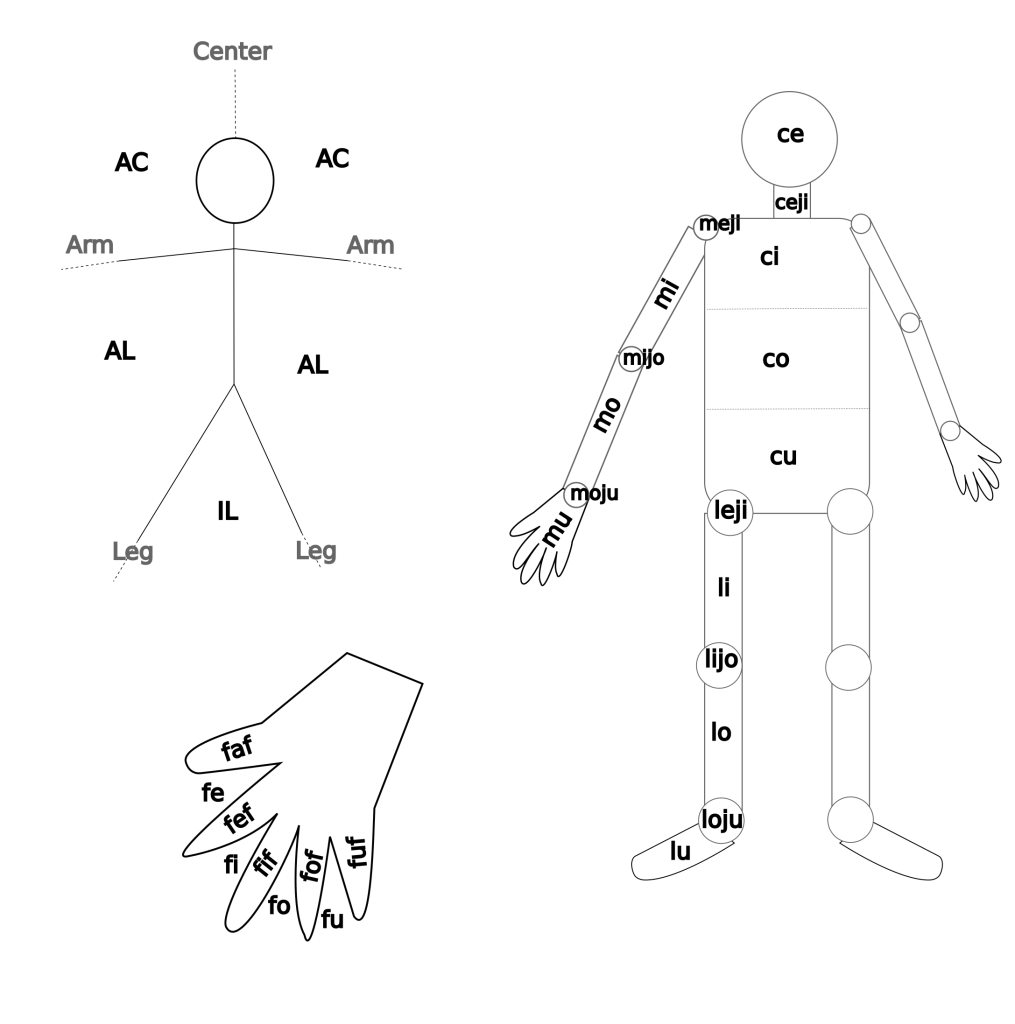
Finer body position
M/L/C + e/i/o/u
+ p + e/i/o/u (from top to bottom)
+ b/c/d/f (back / center / d for outside / front)
C + e +
- n nose
- f front
- m mouth
- c chin
- r ear
- t top
- b back
Examples:
Rac Mipud -> Roll on the lowest part of the upper arm on the outside in the AC zone
T modifications for spin / clubs
to be added
Phonology
Some ideas how to read the syllables / why the syllables are chosen as they are. To be continued.
Syllables:
CV or CVC
V (vocals):
- a father
- e sense
- i think
- o top
- u through / cool
C (consonants):
- B bed
- C can used for Center (body part)
- D doodle
- F fan used for Finger (body part)
- G grip / get used for Grip description
- H hand (or silent)
- J journal
- K (like C, used for mnemonic reasons)
- L look used for Leg (body part)
- M my used for Arm (body part)
- N new used for Empty Hand Movement
- P put
- R read used for Rolling Movement
- S sit used for Setting Movement
- T toss used for Tossing Movement
- V/W van / walk used for Walk / Move with object
in Hand - Z zone
 DuO KaRii